
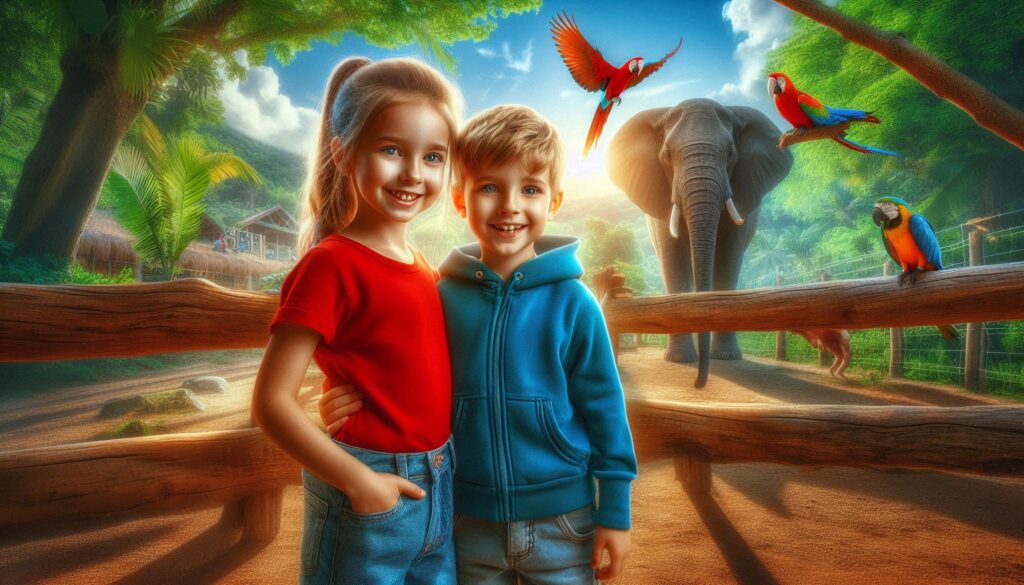
Welcome to our A2 story!
In this post, you’ll learn with the story ‘A Day at the Zoo’
You can watch the video, read the transcript, and practice the most important vocabulary.
👉 Grammar focus: Adjective declension without article.
Enjoy learning!
🚀 Jump to section
🔍Transcript:
Here is the complete transcript of the story, in both German and English.
You can refer to it while watching the video, or read it separately to deepen your understanding.
Deutsch:
Ein Tag im Zoo.
Es ist Samstag. Lea und ihr Bruder Jonas besuchen den Zoo.
Das Wetter ist schön, die Sonne scheint, und es ist warm.
Gleich am Eingang sehen sie große Elefanten.
„Wow, die sind ja riesig!“, sagt Jonas.
Lea macht viele Fotos mit ihrem Handy.
Sie laufen weiter und kommen zu den Affen.
Die Affen springen auf hohen Bäumen und machen lustige Geräusche.
Ein Affe bekommt eine Banane von einem Pfleger.
„Ich möchte auch mal ein Tier füttern!“, sagt Jonas.
Der Pfleger lacht: „Vielleicht beim nächsten Mal!“
Dann sehen sie bunte Papageien in einem Käfig.
Die Vögel singen laut und fliegen hin und her.
Lea sagt: „So laute Tiere habe ich noch nie gehört!“
Im Löwengehege liegt ein Löwe in der Sonne.
Er sieht sehr faul aus.
„Das ist ein müder Löwe“, sagt Jonas und gähnt.
Lea lacht: „Du bist auch müde!“
Sie kaufen ein Eis und setzen sich auf eine Bank.
Kinder laufen um sie herum und rufen: „Da vorne sind Zebras!“
Jonas steht schnell auf und sagt: „Komm, wir schauen uns neugierige Zebras an!“
Am Ende des Tages sind Lea und Jonas müde, aber glücklich.
„Das war ein schöner Tag“, sagt Lea.
Jonas nickt: „Ich will bald wiederkommen.“
English:
A Day at the Zoo.
It’s Saturday. Lea and her brother Jonas are visiting the zoo.
The weather is nice, the sun is shining, and it’s warm.
Right at the entrance, they see big elephants.
“Wow, they’re huge!” says Jonas. Lea takes many photos with her phone.
They walk on and come to the monkeys.
The monkeys jump on tall trees and make funny noises.
A monkey gets a banana from a zookeeper.
“I want to feed an animal too!” says Jonas.
The zookeeper laughs: “Maybe next time!”
Then they see colorful parrots in a cage.
The birds sing loudly and fly back and forth.
Lea says, “I’ve never heard such loud animals before!”
In the lion enclosure, a lion is lying in the sun.
He looks very lazy.
“That’s a tired lion,” says Jonas, yawning.
Lea laughs: “You’re tired too!”
They buy ice cream and sit down on a bench.
Children run around them and shout, “There are zebras up ahead!”
Jonas quickly stands up and says,
“Come on, let’s go see the curious zebras!”
At the end of the day, Lea and Jonas are tired but happy.
“That was a lovely day,” says Lea.
Jonas nods: “I want to come back soon.”
📚Vocabulary:
Nomen (Nouns)
| Deutsch | English | Beispielsatz (Deutsch) | Example Sentence (English) |
|---|---|---|---|
| das Tier | animal | Im Zoo sehen wir viele interessante Tiere. | We see many interesting animals at the zoo. |
| der Zoo | zoo | Am Wochenende besuchen wir den Zoo. | We visit the zoo at the weekend. |
| der Affe | monkey | Die Affen spielen fröhlich im Gehege. | The monkeys play happily in the enclosure. |
| der Papagei | parrot | Ein Papagei sitzt auf einem Ast und spricht nach. | A parrot sits on a branch and mimics words. |
| der Elefant | elephant | Der Elefant spritzt Wasser mit seinem Rüssel. | The elephant sprays water with its trunk. |
| der Löwe | lion | Der Löwe schläft friedlich in der Sonne. | The lion sleeps peacefully in the sun. |
| der Käfig | cage | Die Vögel sitzen im großen Käfig. | The birds sit in the big cage. |
| der Pfleger | zookeeper | Der Pfleger kümmert sich um die Tiere. | The zookeeper takes care of the animals. |
| die Giraffe | giraffe | Die Giraffe frisst Blätter von den hohen Bäumen. | The giraffe eats leaves from the tall trees. |
| der Besuch | visit | Unser Besuch im Zoo war sehr schön. | Our visit to the zoo was very nice. |
Verben (Verbs)
| Deutsch | English | Beispielsatz (Deutsch) | Example Sentence (English) |
|---|---|---|---|
| füttern | to feed | Der Pfleger füttert die Affen mit Bananen. | The zookeeper feeds the monkeys with bananas. |
| herumlaufen | to walk/run around | Die Kinder laufen laut lachend im Zoo herum. | The children run around the zoo, laughing loudly. |
| sehen | to see | Wir sehen viele verschiedene Tiere im Zoo. | We see many different animals at the zoo. |
| schlafen | to sleep | Der Löwe schläft stundenlang in der Sonne. | The lion sleeps for hours in the sun. |
| spielen | to play | Die Affen spielen zusammen im Gehege. | The monkeys play together in the enclosure. |
| fliegen | to fly | Die Vögel fliegen hoch über dem Zoo. | The birds fly high above the zoo. |
| besuchen | to visit | Viele Familien besuchen am Sonntag den Zoo. | Many families visit the zoo on Sunday. |
| lachen | to laugh | Die Kinder lachen laut, als sie die Affen sehen. | The children laugh loudly when they see the monkeys. |
| klettern | to climb | Der Affe klettert geschickt auf den Baum. | The monkey climbs skillfully onto the tree. |
| laufen | to walk/run | Die Giraffen laufen langsam durch ihr Gehege. | The giraffes walk slowly through their enclosure. |
Adjektive (Adjectives)
| Deutsch | English | Beispielsatz (Deutsch) | Example Sentence (English) |
|---|---|---|---|
| bunt | colorful | Die bunten Papageien fliegen durch den Käfig. | The colorful parrots fly through the cage. |
| müde | tired | Nach dem Zoobesuch sind Lea und Jonas sehr müde. | After the zoo visit, Lea and Jonas are very tired. |
| laut | loud | Die Kinder lachen laut im Zoo. | The children laugh loudly in the zoo. |
| hungrig | hungry | Der Bär sieht sehr hungrig aus. | The bear looks very hungry. |
| spannend | exciting | Der Zoobesuch war für die Kinder sehr spannend. | The zoo visit was very exciting for the children. |
| freundlich | friendly | Der Pfleger ist sehr freundlich zu den Besuchern. | The zookeeper is very friendly to the visitors. |
| groß | big | Der Elefant ist ein sehr großes Tier. | The elephant is a very big animal. |
| klein | small | Ein kleines Äffchen sitzt auf dem Ast. | A small monkey sits on the branch. |
| interessant | interesting | Die Giraffen sind für die Kinder sehr interessant. | The giraffes are very interesting for the children. |
| wild | wild | Im Zoo gibt es viele wilde Tiere. | There are many wild animals in the zoo. |
🧠Grammar: Adjective declension without article
Today you will learn the adjective endings when there is no article before the noun.
🧩Overview of the endings:
| Case | Masculine | Feminine | Neuter | Plural |
|---|---|---|---|---|
| Nominative | großer Löwe | bunte Blume | kleines Tier | laute Affen |
| Accusative | großen Löwen | bunte Blume | kleines Tier | laute Affen |
| Dative | großem Löwen | bunter Blume | kleinem Tier | lauten Affen |
📝 Examples from the story:
- Accusative Plural:
„Ich sehe bunte Papageien.“ - Nominative Plural:
„Im Zoo gibt es laute Tiere.“ - Nominative Masculine:
„Das ist ein müder Löwe.“
💡 Tip for learning
If you’re unsure, think of the definite articles (der, die, das) — the adjective endings are exactly the same.
🎯 Mini Exercise:
Now let’s practice adjective declension without an article.
👉 Always pay attention to the case (Kasus) and gender (Genus) of the noun.
⚡ Learning tip
Remember:
- Accusative plural → the ending is almost always -e or -en, depending on the noun.
- Without an article, the endings follow the same pattern as the definite articles (der, die, das).
💡 Bonus tips for using this list:
✅ Learn the words in full sentences to better memorize the context!
✅ Connect similar words – e.g. “besuchen” (to visit) and “das Museum” (the museum).
✅ Write your own sentences using the new vocabulary!

📩 Subscribe to our YouTube channel and listen to more stories!
Get the free German Starter Kit by signing up for our newsletter!
What was your favorite part of the story today? Or have you ever had a similar experience?
Share your thoughts in the comments – I’d love to hear from you! 😊↓