Welcome to our B1 story!
In this post, you’ll learn with the story ‘The Lost Passport’.
You can watch the video, read the transcript, and practice the most important vocabulary.
👉 Grammar focus: The Present Tense Passive.
Enjoy learning!
🚀 Jump to section
🔍Transcript:
Here is the complete transcript of the story, in both German and English.
You can refer to it while watching the video, or read it separately to deepen your understanding.
Deutsch:
Der verlorene Reisepass.
Anna steht am Flughafen in Berlin. Sie fliegt heute nach Kanada – ein lang geplanter Urlaub.
Am Check-in fragt die Mitarbeiterin freundlich:
„Ihren Reisepass, bitte.“
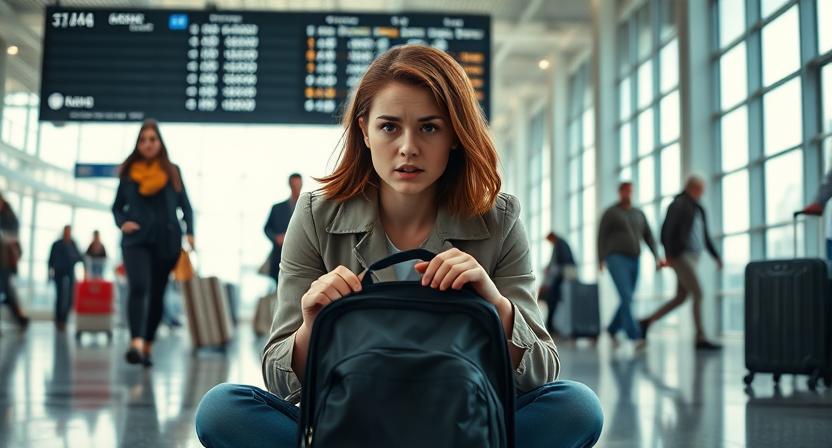
Anna greift in ihre Tasche – und wird plötzlich nervös. Der Pass ist weg!
Sie sucht in ihrer Jacke, im Rucksack, sogar auf dem Boden – doch der Reisepass wird nicht gefunden.
Ein Mitarbeiter wird gerufen. Er fragt:
„Wann haben Sie den Pass zuletzt gesehen?“
„Vor einer Stunde – beim Café in der Abflughalle“, sagt Anna.
Sofort wird ein Sicherheitsdienst informiert. Die Kameraaufnahmen werden überprüft.
Während Anna wartet, wird sie immer unruhiger.
Ohne Pass kann kein Flug stattfinden – und das Flugzeug wird bald gestartet.
Plötzlich kommt ein Sicherheitsbeamter zurück.
„Ein Pass wurde gefunden. Er lag unter einem Stuhl im Café.“
Anna atmet auf. Der Pass wird überreicht – sie ist erleichtert.
Am Schalter wird das Ticket gescannt, der Pass wird kontrolliert – alles ist in Ordnung.
Anna darf endlich zum Gate.
Und sie denkt sich: Beim nächsten Mal wird besser aufgepasst!
English:
The Lost Passport.
Anna is standing at the airport in Berlin.
She is flying to Canada today — a long-planned vacation.
At check-in, the staff member politely asks, “Your passport, please.”
Anna reaches into her bag — and suddenly gets nervous. The passport is gone!
She searches in her jacket, in her backpack, even on the floor — but the passport is not found. An employee is called.
He asks, “When did you last see the passport?”
“An hour ago — at the café in the departure hall,” says Anna.
Immediately, the security service is informed. The camera footage is checked. While Anna waits, she becomes increasingly anxious.
Without a passport, no flight can take place — and the plane will soon take off. Suddenly, a security officer comes back.
“A passport was found. It was under a chair in the café.”
Anna breathes a sigh of relief. The passport is handed back to her — she is relieved.
At the counter, the ticket is scanned, the passport is checked — everything is in order. Anna is finally allowed to go to the gate.And she thinks to herself:
Next time, I will be more careful!
📚 Vocabulary list:
Nomen (Nouns)
| Deutsch | English | Beispielsatz (Deutsch) | Example Sentence (English) |
|---|---|---|---|
| der Reisepass | passport | Der Reisepass wird am Flughafen kontrolliert. | The passport is checked at the airport. |
| die Polizei | police | Die Polizei wird gerufen, wenn ein Dokument verloren geht. | The police are called when a document goes missing. |
| das Dokument | document | Ein neues Dokument wird im Amt ausgestellt. | A new document is issued at the office. |
| der Flughafen | airport | Am Flughafen wird der Pass überprüft. | The passport is checked at the airport. |
| der Sicherheitsbeamte | security officer | Ein Sicherheitsbeamter bringt den gefundenen Pass zurück. | A security officer brings back the found passport. |
| das Formular | form | Ein Formular wird am Schalter ausgefüllt. | A form is filled out at the counter. |
| das Ticket | ticket | Das Ticket wird vor dem Einsteigen kontrolliert. | The ticket is checked before boarding. |
| die Tasche | bag | Anna sucht den Reisepass in ihrer Tasche. | Anna looks for the passport in her bag. |
| die Abflughalle | departure hall | Der Pass wurde in der Abflughalle gefunden. | The passport was found in the departure hall. |
| das Gate | gate | Anna geht schnell zum Gate, um ihr Flugzeug zu erreichen. | Anna hurries to the gate to catch her plane. |
Verben (Verbs)
| Deutsch | English | Beispielsatz (Deutsch) | Example Sentence (English) |
|---|---|---|---|
| verloren gehen | to get lost | Der Pass ist irgendwo verloren gegangen. | The passport got lost somewhere. |
| ausgestellt werden | to be issued | Ein vorläufiger Pass wird oft am Flughafen ausgestellt. | A temporary passport is often issued at the airport. |
| kontrolliert werden | to be checked | Der Reisepass wird am Flughafen kontrolliert. | The passport is checked at the airport. |
| rufen | to call | Die Polizei wird gerufen. | The police are called. |
| finden | to find | Ein Pass wurde unter einem Stuhl gefunden. | A passport was found under a chair. |
| überprüfen | to check/verify | Die Kameraaufnahmen werden überprüft. | The camera recordings are checked. |
| suchen | to search/look for | Anna sucht verzweifelt nach ihrem Pass. | Anna searches desperately for her passport. |
| geben | to give | Der Pass wird Anna überreicht. | The passport is handed to Anna. |
| sein | to be | Ohne Pass ist der Flug nicht möglich. | Without a passport, the flight is not possible. |
| denken | to think | Anna denkt sich, dass sie nächstes Mal besser aufpassen wird. | Anna thinks that next time she will pay more attention. |
Adjektive (Adjectives)
| Deutsch | English | Beispielsatz (Deutsch) | Example Sentence (English) |
|---|---|---|---|
| verloren | lost | Der verlorene Reisepass sorgt für Stress. | The lost passport causes stress. |
| vorläufig | temporary | Ein vorläufiger Pass wird ausgestellt. | A temporary passport is issued. |
| nervös | nervous | Anna wird nervös, als sie den Pass nicht findet. | Anna becomes nervous when she can’t find the passport. |
| erleichtert | relieved | Anna ist erleichtert, als der Pass gefunden wird. | Anna is relieved when the passport is found. |
| freundlich | friendly | Die Mitarbeiterin am Check-in ist freundlich. | The staff at check-in is friendly. |
| wichtig | important | Der Reisepass ist ein wichtiges Dokument. | The passport is an important document. |
| schnell | quick/fast | Anna geht schnell zum Gate. | Anna hurries quickly to the gate. |
| beruhigt | calm/relieved | Nachdem der Pass gefunden wurde, ist Anna beruhigt. | After the passport is found, Anna is calm. |
| verzweifelt | desperate | Sie sucht verzweifelt nach dem Pass. | She searches desperately for the passport. |
| unruhig | restless | Während sie wartet, wird Anna unruhig. | While waiting, Anna becomes restless. |
🧠Grammar: The Present Tense Passive
The present tense passive is an important grammar structure at the B1 level.
It shows what is being done to something without specifying who is performing the action.
👉 This is useful when the person performing the action is unknown or not important.
Formation of the present tense passive: werden + past participle
Examples:
- Der Pass wird gesucht. → The passport is being searched for.
- Ein Mitarbeiter wird gerufen. → An employee is being called.
- Die Kameraaufnahmen werden überprüft. → The camera recordings are being checked.
- Ein Formular wird ausgefüllt. → A form is being filled out.
❔Why is this important?
- In everyday situations (travel, police, documents), the passive voice is used very frequently.
- It is especially common in news reports, announcements, or official contexts.
👉 Tip for German learners:
Practice with simple sentences from your surroundings.
For example:
- „Das Ticket wird kontrolliert.“ → “The ticket is being checked.”
- „Der Koffer wird geöffnet.“ → “The suitcase is being opened.”
🎯Mini Exercise:
⚡Now it’s your turn! Test your knowledge of the present tense passive with examples from our story ‘The Lost Passport‘.
Very good! You’ve understood the present tense passive. Keep practicing with other sentences from everyday life or your travel experiences.
💡 Bonus tips for using this list:
✅ Learn the words in full sentences to better memorize the context!
✅ Connect similar words – e.g. “besuchen” (to visit) and “das Museum” (the museum).
✅ Write your own sentences using the new vocabulary!

📩 Subscribe to our YouTube channel and listen to more stories!
Get the free German Starter Kit by signing up for our newsletter!
What was your favorite part of the story today? Or have you ever had a similar experience?
Share your thoughts in the comments – I’d love to hear from you! 😊↓